

Not all leather is created equal
Don't get caught out!

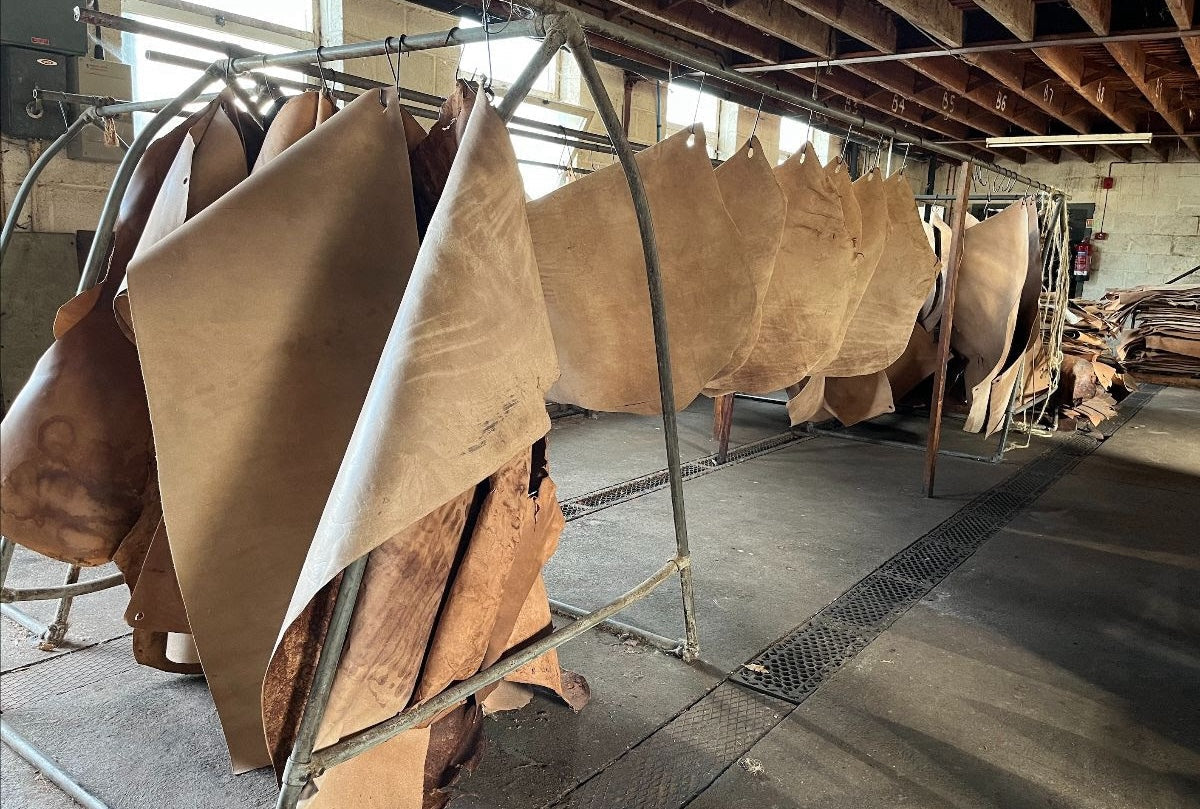
*Photo of some beautiful full grain oak bark tanned hides at the world renowned Baker's Tannery here in Devon
Know your full grain from your genuine leather, your vegetable tan from your chrome tan, and your butt from your shoulder or belly!
In this short three part series, we're going to (hopefully) shed some light on the often overlooked variances in leather available to you.
Know your leather: Part 2
Full Grain Vs Top Grain Vs Genuine or Bonded Leather
It is confusing... leather is leather right?
No.
Here at Tanner Bates, we use full grain vegetable tanned leather. In our opinion, this is the crème de la crème.

Now, what is full grain?
Full grain simply means that the top surface of the leather (the grain side), has not been sanded, buffed, coated, or otherwise messed with. Every mark that was on the animal's skin will be visible on the leather. We like to celebrate these characteristics as they make each piece as unique as the animal the skin came from. The structure and fibres of the leather are left intact.
However, many modern brands do not like to see the individual characteristics of the leather and opt to have the surface of the leather 'Grain Corrected' or 'Top Grain', in order that each piece is completely devoid of any natural marks and completely uniform. To achieve this, the leather is sanded and buffed, maybe even refinished with a new artificial surface layer and embossed with an artificial grain pattern. This essentially damages and/or removes the natural grain and structure of the leather, weakening it.

*Photo of some beautiful full grain oak bark tanned hides at the world renowned Baker's Tannery here in Devon
Next up is 'Genuine Leather'. If you see this, run a mile!
Genuine leather is a leather split, which means that the top (most beautiful, strongest and valuable) layer of the leather has been removed. What you are left with is the 'split', the underneath of the hide. There is no strength here, and it isn't pretty either. The surface will need to be finished artificially to give the appearance of leather.
Finally, there is 'Bonded Leather'. Almost not worth talking about, definitely worth avoiding!
The manufacturing process begins with the collection of discarded leather fragments, which are then shredded and pulverised into a fine powder. This leather pulp is subsequently combined with polyurethane or latex binders, creating a malleable material that can be moulded and embossed to mimic the appearance of genuine leather.

In short, if you're buying anything leather, and it isn't immediately obvious, ask.
Ask how was the leather tanned.
Ask if it is full grain.
Ask who made the product.
In our opinion:
If the person selling it cannot answer, don't buy it.
When you buy a Tanner Bates piece, we can answer these questions…

So, if you've supported us before, or are considering your first piece, thank you. It genuinely makes a difference.
With love from Devon,
Rick, Matt & Matthew

